What Time of Year Do Goats Have Babies?
Direction PRACTICES
Determination of Age
The age of a goat judged from its front teeth (incisors) on the lower jaw. There are no teeth on the upper jaw. The kid at birth, or soon afterward, has teeth on the lower jaw. These are known as suckling teeth. They are pocket-size and sharp in kids. When the kid is 12 to 14 months one-time the key pair is shed and is replaced by two large permanent teeth; when 24 to 26 months old two more small teeth are shed and are replaced by two big teeth, one on each side of the first pair; when 36 to 38 months old in that location are six permanent teeth, and when 48 to fifty months one-time a complete gear up of four pairs of permanent teeth are present. Occasionally teeth develop much more quickly and the goat may take all its permanent teeth by the time it is three years old. Once all the permanent teeth have adult the caste of clothing and tear gives a crude indication of age. The teeth commencement wearing four to six weeks after eruption. Wearing of teeth depends upon the type of feed and care given to the animals. Some may-mature early on and others late. Historic period of eruption of teeth serves every bit a reasonable and dependable guide for judging maturity.
Identification
Each goat in a herd should exist marked in the aforementioned fashion by using some identification mark such as tattooing, metal ear-tags or notching of the ears. The tattooing system is used nigh universally.
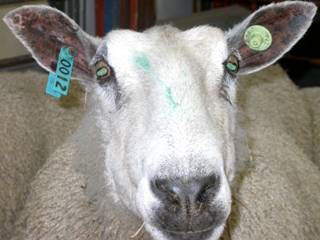
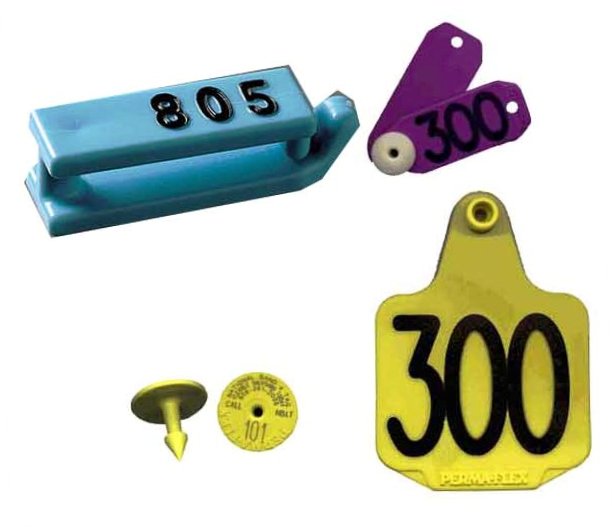
Tagging in caprine animal & Different type of Tags
Disbudding and Dehorning
This should exist done when the male child is two to five days old and the female child is up to 12 days sometime. The hair should be clipped from effectually the horn-bud, and this area covered with petroleum jelly to protect it from caustic soda or potash, which should exist thoroughly rubbed on the bud until the horn-bud is well blistered. Caustic soda should non come into contact with the eyes. An electrical de homer can as well be used safely. 'The child should be muzzled gently and so that it can breathe freely; otherwise fractional suffocation may occur. Mature goats tin can exist dehorned past sawing off the horns close to the head with a meat saw. This should be done in winter when flies are non troublesome. The wound should be dressed.
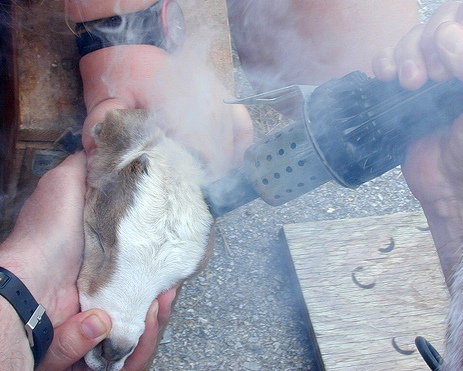
Disbudding
Castration
Male goats are raised mainly for meat and not for convenance. For this reason males are castrated with an emasculator, or torsion forceps. The all-time time for castrating bucks is when they are six months one-time with the Burdizzo instrument. This avoids all risks of infection. Castration improves the flesh of the adult buck. A castrated male is' called a wether.
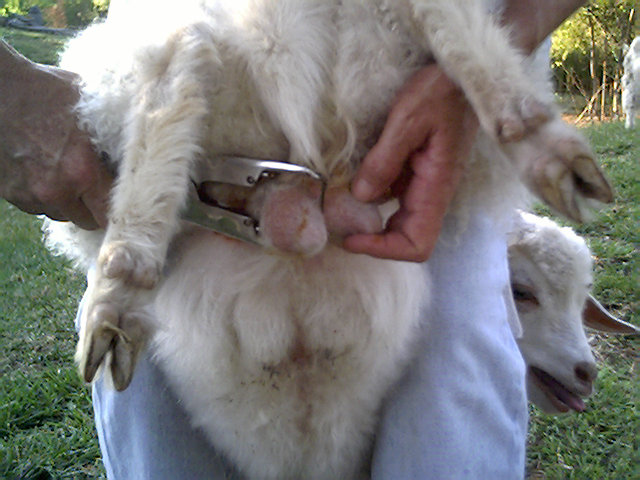
Castration
Practise
The goats require exercise for maintaining themselves in a good condition. Stock on range receive sufficient practise while grazing. Stall-fed goats should be permit loose in a large paddock for at to the lowest degree 3 to 4 hours a solar day. The bigger the paddock, the better they enjoy. Goats should non be let loose in the paddock or sent out for grazing until the dew has dried up, i.e. not until i to two hours after sunrise. Grazing on wet grass with dew is probable to result in tympanites and abdominal inflammation.
Hoof Trimming
Hoof trimming is necessary for the well-existence of goats. If neglected it can weaken legs, ruin feet and lower milk production. The goats shortly get used to trimming equally a monthly routine. Precipitous pen-knives or curved hand-pruning shears can be used finer.
Selecting the Doe
An outstanding doe is the nucleus of a productive herd. Selection of a doe should exist made with great intendance. Proficient body development is essential for high milk product. The doe should exist well grown, healthy in advent, and stand up squarely on her feet and not down on the pastern. The body should be wedge-shaped and sharp at the withers. The depth of the ribs denotes capacity for consuming large amounts of nutrient. The thighs should provide plenty of room for a circular, well attached udder of off-white size.
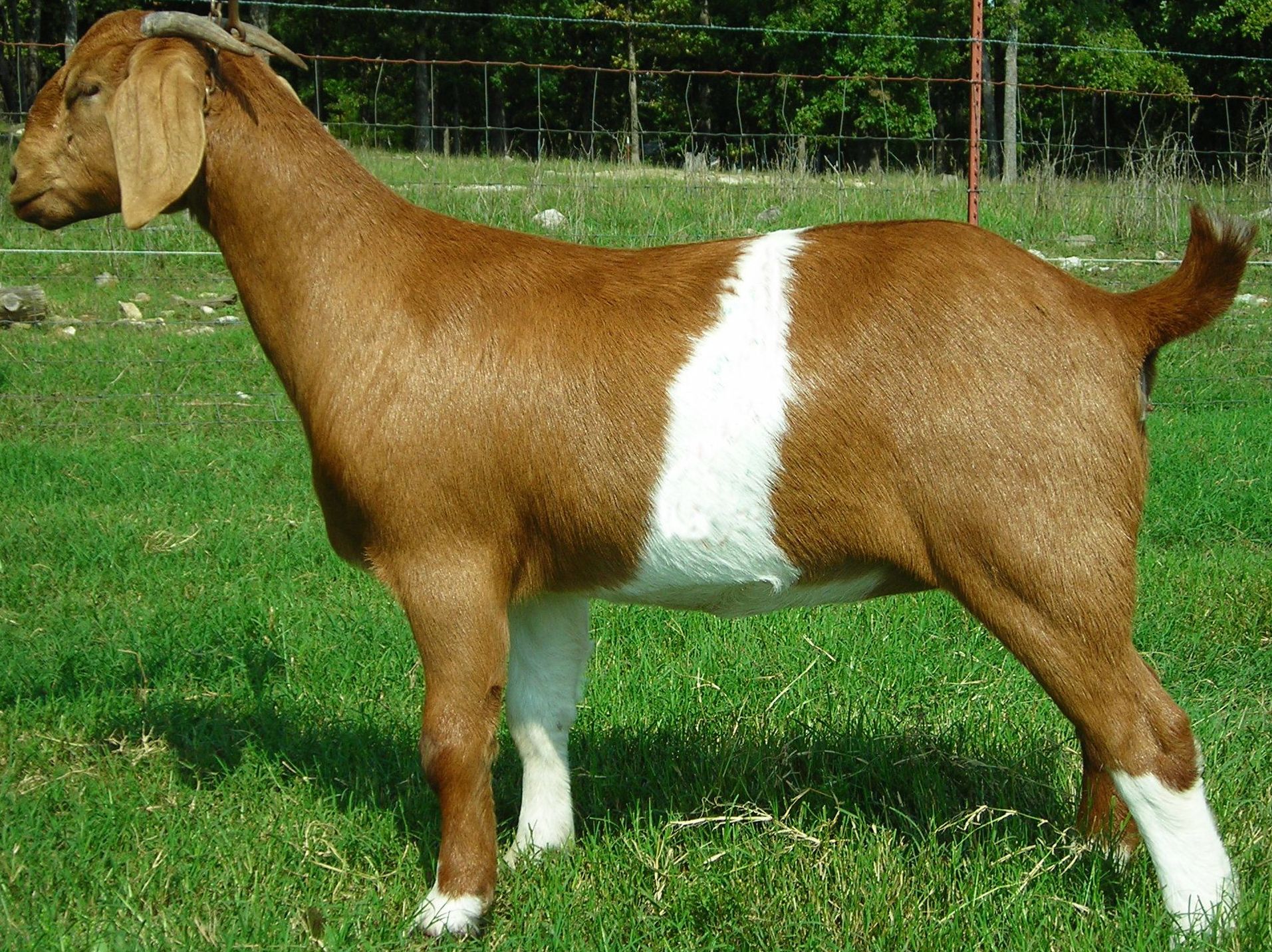
Doe
The pare should be loose, pliable and free from dryness. Poor condition of flesh may exist an indication of a good milker, while a poor milker may be in good flesh. The neck should be thin and the head narrow. The eyes should exist clear and bright. Does should exist truly feminine in appearance and mild in temperament. It is difficult to handle, milk, feed and manage nervous goats. The milk potential cannot be estimated from the size of the udder. The udder of a skillful milch goat should be soft and pliable rather than meaty. The teats should be pointed slightly forward. The udder in a freshly milked goat should have a collapsed appearance.
Selecting the Buck
The buck should have a strong, well-adult frame, and good conformation and breed characters. Skilful depth of ribs is essential. Legs should be straight and well placed under the body. The buck should be healthy and free from external and internal parasites. He should be chosen from a proficient milking strain and should exist the progeny of dams having good performance record. Poor condition of mankind is not a serious drawback, since bucks unremarkably worry a skillful deal, peculiarly during the rutting season. Many herdsmen prefer the bucks to be hornless. A well grown buck child perchance bred to 'five or vi does during his outset season at an approximate historic period of six months. When 18 to 24 months old he may be permitted to service 25 to thirty does, and when fully mature 50 to 60 does in a breeding season.
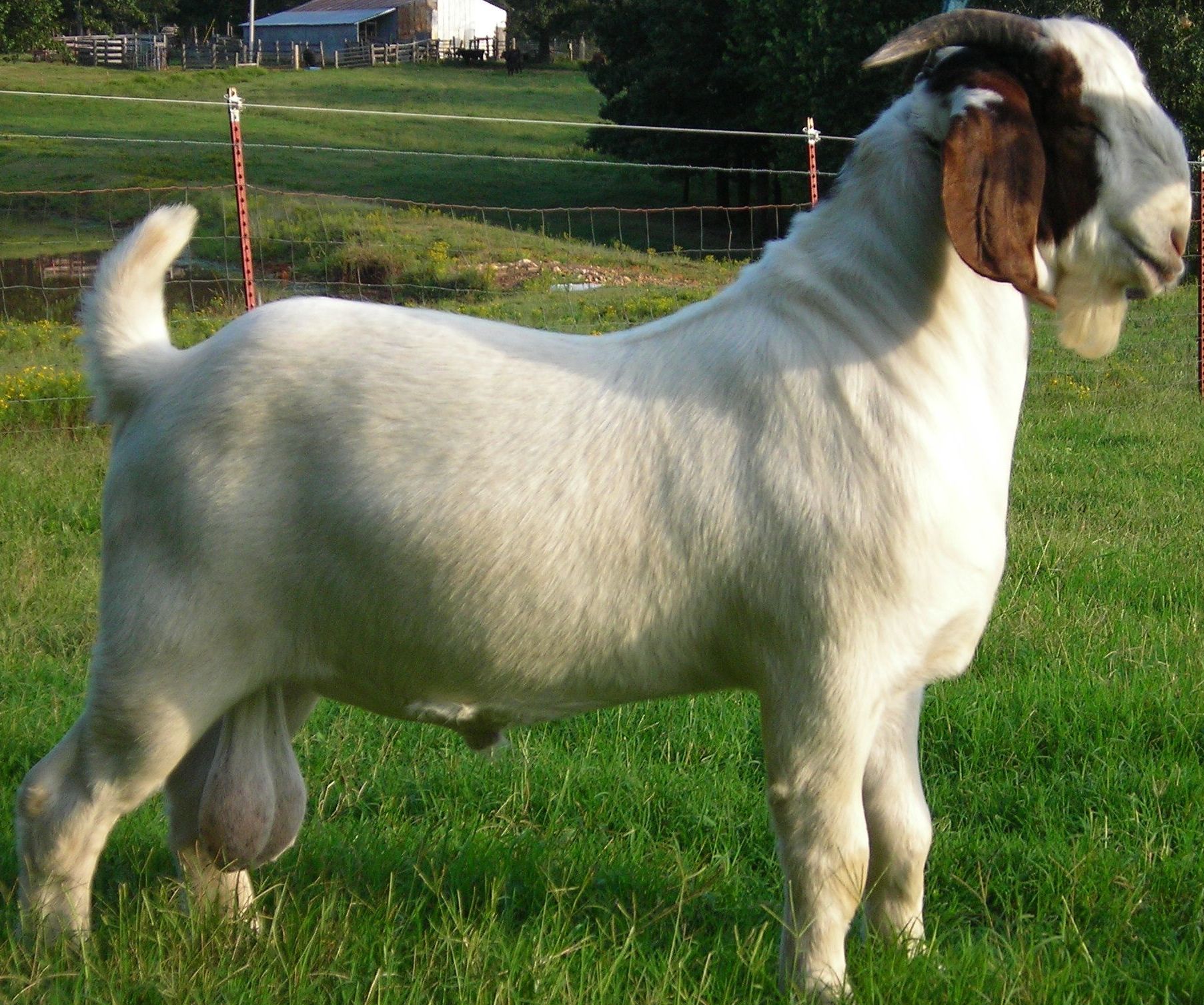
Buck
Mating Season
The does are more or less continuous breeders. The signs of heat in the doe usually are uneasiness, tail shaking, pink and swollen genitalia, frequent urination, restlessness, bleating and a little mucous discharge for one to three days. The period between heats varies from 18 to 21 days. It is better to inseminate the doe on the 2nd twenty-four hour period of the heat period. The sperms survive in the female genital tract for 22 to 42 hours. Mating should exist then timed that the kids are born in a season when mortality amongst them is at its everyman and an acceptable corporeality of food is available for their nourishment and growth. Breeding seasons will, therefore, vary with breed, locality and climate.
Mating of the Doe
Does may be mated when 10 to 15 months onetime so that they kid at the age of 15 to 20 months. But equally a rule a caprine animal should not exist mated until it is one yr old. The average gestation period is 151 ±3 days. It is better to brood the female once a year. Some goats tin can be made to child twice in 18 months. The goats reach their maximum efficiency at the age of five to vii years. In exceptional cases they continue to be serviceable even upward to 12 years and in rare cases up to 14 years. A well maintained doe may continue to be milked until a calendar month before she is expected to kid again. The condition of the doe during gestation will accept a very great influence on the quality of kids at birth. A doe in good condition volition produce potent lively kids, whereas a doe in poor status may produce ungainly kids, weak in constitution. Does must be fed well, allowed liberal practice and protected from rain and cold.
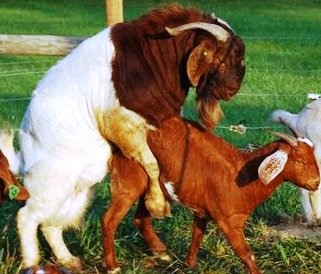
Mating
Goats in Kid
A temporary increment in milk yield later mating is considered to exist an indication of pregnancy, but the first sign that a doe is in kid is the cessation of the Journal return of oestrus. During the first three months of pregnancy in that location is petty alteration in the shape of the in-kid does. The caput of the child can sometimes exist felt from half-dozen to viii weeks. An quondam doe or a young doe which is to requite nascence to one kid may exist very misleading in appearance and show no sign of pregnancy. 6 to viii weeks before kidding, young does commence to bear witness udder evolution, simply this is by no means a sure sign of pregnancy as they will frequently bear witness such development and even have milk in the udder when they are non in kid.
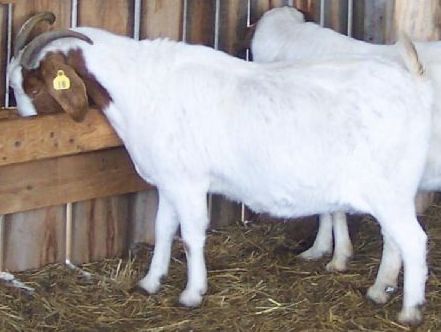
Meaning Doe
An average goat tin can rear well ii kids. Goats are known to give nascence to equally many as v kids at a time, only nascence of such large numbers affects the health of the caprine animal. The incidence of twinning varies with the brood, environment and number of kidding. The Beetal goats at Hisar Farm produced in a year, on an average, 35 per cent singlet, 54 per cent twins, 6·3 per .cent triplets and 0·four per cent quadruplets. In Jamunapari the per centum of twinning varies from 19 to fifty with an average of 35, and in Barbari from 47 to seventy.
(Source: MedicoAchariya, Handbook of Animal Husbandry).
© 2009-15 TNAU. All Rights Reserved.
Source: https://agritech.tnau.ac.in/animal_husbandry/ani_goat_mgt%20practices.html
0 Response to "What Time of Year Do Goats Have Babies?"
Post a Comment